
Thinking About the Scale at Which We Live Our Lives
This summer I drove from Montreal, Quebec to Woodstock, New Brunswick. Montreal is, of course, a decent-sized city but Woodstock New Brunswick seemed like a town so tiny that I was kind of scared to be there. Maybe not tiny in reality. The official census population clocks in at over 5,000. Not that tiny.
But I was driving through New Brunswick as darkness was approaching.
THERE WAS NOBODY ON THE ROAD
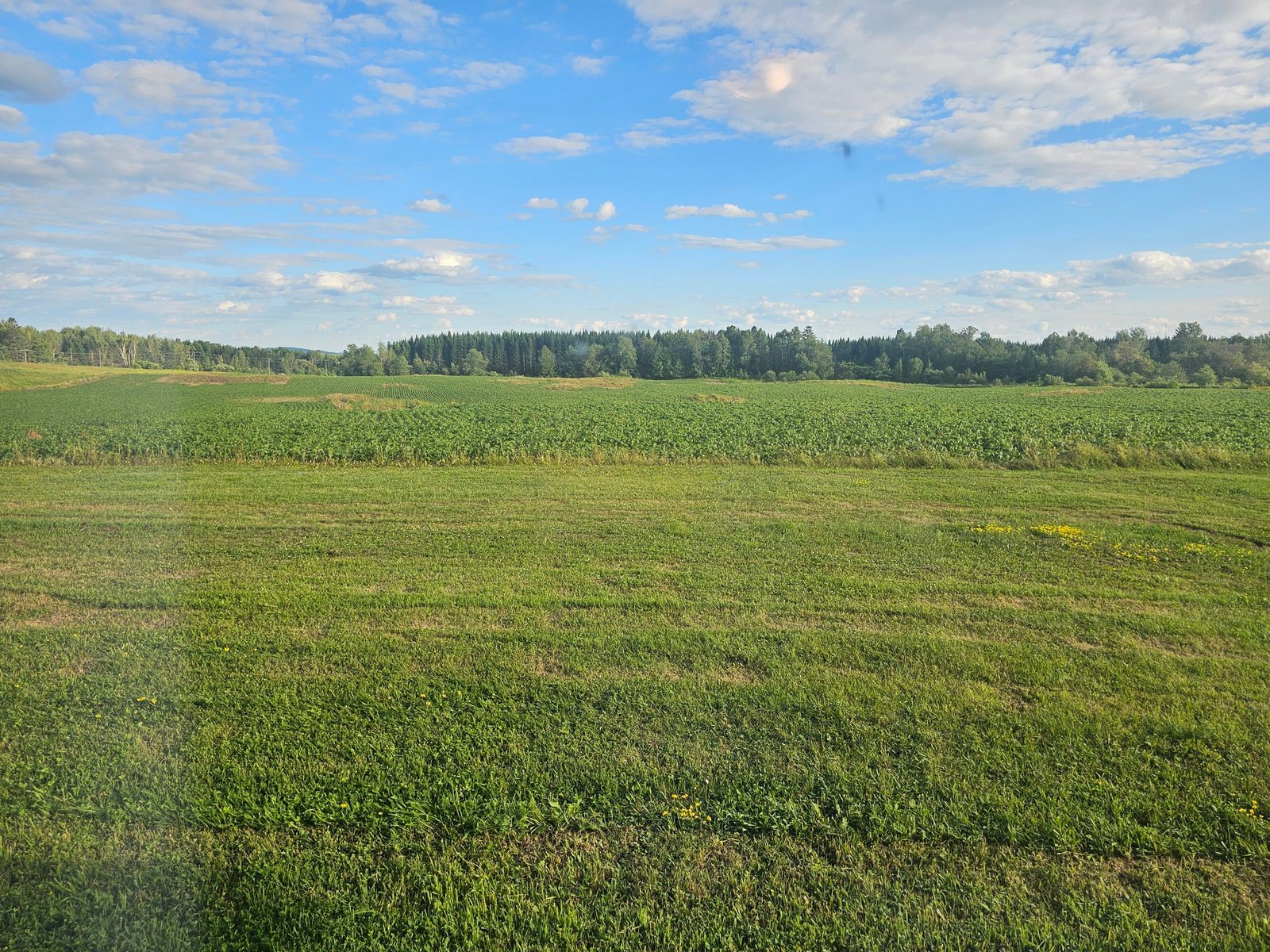
I could see vast potato farms. There was a sign for the ‘French Fry Capital of the World’, which I found charming. But there were very few vehicles in sight.
Rolling hills, up and down. Quite beautiful. But very lonely. One of the few places on my summer road trip that made me say to myself, “I could not live here.”
I would not want to break down alone on a road at night where there is no vehicle traffic and nobody in any direction for more than 50 km.
So I pulled off the road, maybe I was not at Woodstock yet, but I pulled off the road to find a place to stay for the night. Just in time!
The proprietor of the inn looked a bit weary when I said I had no reservation but gave me a room for slightly more than I expected to pay. While I was waiting to check in, he took a phone call and told a seemingly rather desperate person that HE HAD NO ROOM AT THE INN, he was selling his last room right that very minute.
I got the last room!
Next to a potato farm.

A Massive City
The lack of human habitation made me think about the scale at which we live our lives.
My summer road trip began from one of the most massive cities in the United States. I lived for 23 years in one of the most densely populated areas of that city. Two blocks from the single most heavily trafficked interchange in the US. I commuted to work on the busiest freeway in America.
I don’t live there anymore. I moved about 14 miles away. To an area that seems almost as densely populated with almost as many cars. There are, to put it mildly, people everywhere. Commercial establishments everywhere. Big box stores. There are so many different kinds of Asian restaurants within walking distance of my home that I simply gave up trying to count them.
Different kinds of Asian restaurants. I don’t mean too many restaurants to count. I don’t mean too many restaurants to count with ‘ethnic’ foods, like Mexican or Chinese or Italian or Indian or French or Greek or places that sell kebabs.
The Sheer Scale of Variety in a Big City
I mean different kinds of Asian restaurants. Japanese and Chinese and Thai and Indian – but no wait, sushi and ramen and Mandarin and Sichuan and fusion and Cantonese and Hunan and hot pot and dim sum and Mongolian barbecue and boba and Filipino and teppanyaki and udon and I completely lost count of how many different kinds of Korean and pho and… I just gave up.
The scale at which we live our lives can vary widely. The scale of variety I encounter within 7 miles of my house is just staggering. Compared with driving through New Brunswick, where what appeared to be a single stretch of farmland might last for 7 miles. To put it another way, the scale in New Brunswick came from bucolic countryside.
I’m not trying to say that one type of scale is better than another. What I am saying is that we tend to get used to our own sense of scale.
Driving back to Southern California gave me a new sense of appreciation for the scale of the state where I was born. The deserts are uncompromisingly vast and forbidding; it’s like driving through Mars. The otherworldly surreal landscape that stretches into the sunrise is humbling.
The Mountains!
And the mountains! On my trip, I drove up and down mountains and hills through the eastern side of the North American continent. Smoky Mountains. The Appalachians. And I saw the plattes and buttes and mesas of New Mexico, gorgeous. The mountains of Arizona.
And then I drove into California, and there was no comparison. The mountains are massive. The mountains that ring a sprawling metropolitan area are staggering in their size and scale. And those are just the regular mountains. We’re not even talking about Yosemite or about Mount Whitney. Just the regular mountains that I’m used to.
In New Brunswick, as I crested a hill, I felt like I could see so far into the distance that there was no almost no horizon. It made me uneasy but I didn’t exactly know why.
The Scale of Scenery
When I got back home, I understood. I am used to having my view blocked in every direction by massive mountains. (Or the massive Pacific Ocean.) A baby Santa Ana mountain is a mile high. Normal mountains are close to double that. There are so many mountain ranges in Southern California that nobody who lives here knows the names of them all.
So I’m not used to living somewhere where the scale of scenery makes it seem like a forested land of rolling hills stretches forever, unimpeded by towering peaks.
I marveled at and appreciated the vast vistas of New Brunswick as I was experiencing them. Because they were new to me. But I am not sure a native could appreciate or understand the scale of what they see every day any more than I could appreciate my hometown mountains.
It’s as though you have to step aside to see how big – and how small – the things around you are. I’m beginning to think that whether you live in a tiny town in New Brunswick or a massive city in California, your little spot of the physical world contains something wondrous. If you can just choose to see and appreciate it.
Discover more from Get Pretty Fed Up
Subscribe to get the latest posts sent to your email.