
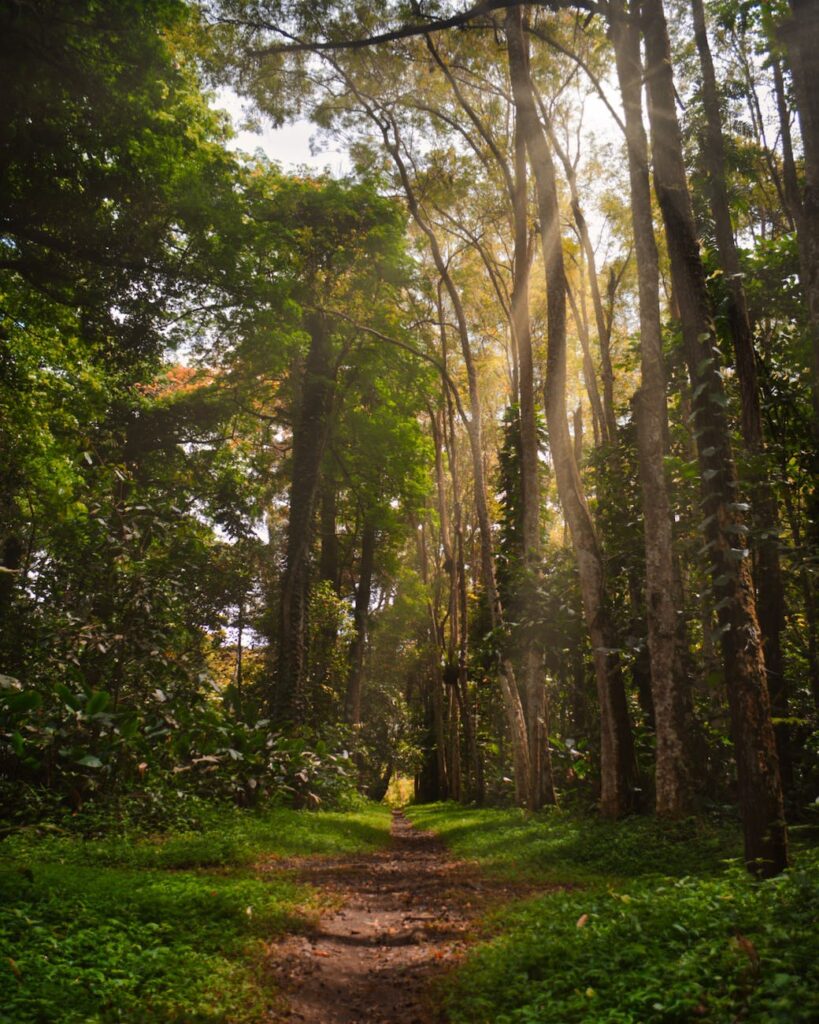

Q. What is a tropical rainforest?
A. Tropical rainforests are one of the planet’s oldest, most unique and densest ecosystems. Like all ecosystems, they include the living and nonliving components of an environment that work together to create a stable home for plants, mammals, fish, microbes, insects, reptiles, amphibians, fungi, and birds. Tropical rainforests are hot and humid (e.g., 77% relative humidity), with rainforests experiencing at least 80 inches of rain in a typical year. Abundant rainfall occurs year-round.
Although home to an astonishing variety of plant life, only about 2.2 percent of tree species comprise about 50% of the trees in a tropical rainforest. Tropical rainforests have layers of plant life, that can be referred to as the shrub layer, under canopy, canopy, and emergent layer (trees that tower over the top of the canopy of tree tops and plants that shelter the rainforest and block out most sunlight from the rainforest floor). The canopy layer is the most densely packed with life.
Q. Where are tropical rainforests located?
A. Tropical rainforests are located in a band stretching around the globe approximately 10 degrees latitude above and below the equator. Rainforests in other parts of the world, such as California, are not considered tropical rainforests.
The world’s largest and most famous tropical rainforest is the Amazon rainforest, located primarily in Brazil. The Amazon rainforest is a very large area of connected rainforest that stretches beyond Brazil into neighboring countries, such as Peru. Africa is home to the second largest tropical rainforest in the world, in the Congo Basin. Malaysia and Indonesia, in southeast Asia, also contain large and important areas of tropical rainforest.

Q. What’s wrong with the tropical rainforests of the world?
A. They’re disappearing at an alarming rate. 60% of the world’s rainforest acreage has disappeared since humans began destroying them. Loss of forest land is called deforestation. About 6 million hectares of forest are lost to deforestation in a typical year. By some estimates, the rainforests of the world lose about 2,000 trees a minute every day of the year.
Although tropical rainforest conservation efforts are seemingly supported worldwide, deforestation is increasing rapidly in some areas. For example, in the African country of Ghana, deforestation increased by 70% in the early 2020’s.
Rapid deforestation brings tropical rainforests dangerously close to a ‘tipping point’ in which a rainforest is changed so irrevocably that is ceases to function as a rainforest at all. The consequences of losing tropical rainforests for the global climate are so potentially large that they’re almost impossible to estimate.
Q. Why should we care about tropical rainforests?
A. Due to their locations near the equator, tropical rainforests absorb vast amounts of the solar radiation that reaches the earth. They help prevent the Earth’s climate from changing more rapidly and drastically than it already is. They are an important source of what is known as climate mitigation. In other words, they help prevent global average temperatures from rising any more than they already have.
Via photosynthesis, rainforests in general contribute 28% to the globe’s oxygen turnover; that is, they extract carbon dioxide from the air and return oxygen to the atmosphere. Tropical rainforests store carbon that would otherwise be released into the atmosphere, making them globally important ‘carbon sinks’. Rainforests are sometimes called the lungs of the earth; they literally help all of us breathe.

Tropical rainforests are also important to biodiversity and the water cycle. It is estimated than about 2/3 of the world’s plant species make their homes in tropical rainforests and half of the world’s animal species. Tropical rainforests are also so lush that they produce their own rainfall and prevent droughts and other adverse impacts on a region’s water supply.
In addition, tropical rainforests have historically been extremely important sources of medical drugs. Both plants and animals in tropical rainforests produce unique substances not found anywhere else in the world, many of which have been valuable to humanity.
70% of the plants that have proven anti-cancer properties are only found in tropical rainforests.
https://www.wwf.org.uk/updates/10-products-come-tropical-forests
Other products most of us take for granted, such as chocolate, also come from tropical rainforests. Unfortunately, local cocoa farmers, many of whom are impoverished, have strong incentives to farm cocoa illegally in protected areas of rainforests.
Deforestation often has devastating effects on the environment locally, and even globally. For example, deforestation can make droughts worse.
Deforestation causes conflict between the native or indigenous people living there, who rely on the forest for sustenance (and who typically are the most skilled at conserving it), and the outside interests who come in to economically exploit the remaining rainforest. Plants and animals living in the rainforest can also go extinct when tracts of rainforest are razed.
Q. What threatens the tropical rainforests of the world?
A. Farming, ranching, and mining all threaten the world’s tropical rainforests. Many of the activities that lead to deforestation are both illegal and unsustainable.
The short-term economic benefits of farming, ranching, and mining on tropical rainforest land are outweighed by the economic costs of losing tropical rainforest acreage forever. For example, deforestation decreases rainfall in the area, which in turn reduces the crop yield of deforested areas cleared for farming. Deforested farmland may only produce crops for a few years before becoming unproductive.
Logging and fires also post significant threats to tropical rainforests, as well as road building. Road building doesn’t just fragment and damage parts of the ecosystem, it allows easier access by those who engage in illegal mining and other destructive activities.
In the past, road building has set off land grabs, illegal logging, and increased deforestation in areas such as Brazil. Political corruption and institutional lack of control are often in play during road construction, increasing the risk of deforestation associated with road building.
”Legal and illegal roads penetrate a remote part of the forest, and small farmers migrate to the area. They claim land along the road and clear some of it for crops. Within a few years, heavy rains and erosion deplete the soil, and crop yields fall. Farmers then convert the degraded land to cattle pasture, and clear more forest for crops. Eventually the small land holders, having cleared much of their land, sell it or abandon it to large cattle holders, who consolidate the plots into large areas of pasture.”
Fears of ‘deforestation rush’ in tropical rain forest if Brazilian congress passes bill to pave Amazon highway — MercoPress
Land and drug trafficking are also major problems, particularly in the Amazon basin. Fires pose a major threat as well. Climate change already underway threatens forests, and Brazil saw horrific fires in the Amazon during the reign of Jair Bolsonaro (who sometimes seemed intent on making sure the Amazon rainforest was completely destroyed before he left office!).
The greater threat to tropical rainforests is that, beyond a certain point, deforestation may make it impossible for tropical rainforests to survive as rainforests at all.
Q. If protecting tropical rainforests is so important, why does deforestation continue and even increase?
A. There is a very simple answer to this question.
…what underlies many failed efforts to end the destruction of rainforests is a simple fact: People can make more money by destroying forests than protecting them, said Kemen Austin, a tropical forest expert at the Wildlife Conservation Society. (emphasis added)
Tropical rainforests are still vanishing at an alarming rate – Vox
Global demand for commodities like timber, beef and soybeans is the underlying driver of deforestation. The economic incentives for selling these commoditeis are so great that a large number of indigenous people have been literally murdered for opposing attempts to destroy their land. Many more have been threatened or harassed.
Current global financial systems simply do not account for the value of intact tropical rainforests and therefore reward deforestation.
Q. What can we do to save the tropical rainforests?
A. There are a number of things humanity can do to save the tropical rainforests before they’re gone.
More than 100 world leaders have promised to end and reverse deforestation by 2030, in the COP26 climate summit’s first major deal.
https://www.bbc.com/news/science-environment-59088498
We must acknowledge that tropical rainforests are complex ecosystems. Even though they’ve been around for millions of years, humans don’t understand them very well. Science is late to the party insofar as studying them goes. Indigenous people, who have been living in and among rainforests for centuries, typically know more about the rainforests and how to conserve them than anyone else. So the first thing to do to save tropical rainforests is:
Let Indigenous People Take the Lead in Managing Conservation Efforts
Nations, regions, and local governments that partner with indigenous groups to monitor, conserve and enforce regulations to protect tropical rainforests gain great benefits. Indigenous people know the land and its people better than any outsider could hope to. They have a vested interest in protecting the land that sustains and has sustained them for centuries. Indeed, tropical rainforest land under the stewardship of indigenous people fares better than land managed by non-local, non-indigenous entities.
Employing indigenous people as monitors, researchers, and enforcers also brings economic benefits to the area, increasing stability and reducing conflict. Lately, indigenous groups have been using smartphone apps equipped with satellite data to report on deforestation in their areas.
In fact, a two-year, peer-reviewed study published in the Proceedings of the National Academy of Sciences (PNAS) found that communities supplied with satellite data via smartphones saw 52% less forest loss than similar communities that did not adopt the technology, in the first year alone.
Direct funding of Indigenous peoples can protect global rainforests & the climate (commentary) (mongabay.com)
Indigenous peoples, where they like it or not, are on the front lines of the fight against inappropriate agricultural, ranching, and mining exploitation of tropical rainforests.
The second thing that has to be done to save tropical rainforests is:
Change the Economic Incentives Around Tropical Rainforests
There is simply too much money to be made in the short term destroying tropical rainforests to dissuade the people who want to exploit them, many of which are criminals or large agricultural, meatpacking, or mining interests with deep pockets and strong motivation to enrich themselves at the expense of everyone else.
This video lays out the harsh economic realities behind global food production and why they have to change:
In the past, major companies, such as McDonalds and Cargills, have been persuaded (shamed by bad publicity and political pressure) to stop buying products such as cattle and soybeans raised on what should have been rainforest land. Efforts continue along these lines, with the European Union passing major legislation to force companies to keep their supply chains free of goods that flout rainforest protections.
Companies and nations backslide when it comes to deforestation because they want the most money in the easiest way. Continuing pressure (and acknowledgement of the real risks of losing tropical rainforest acreage) is essential to changing the economic incentives that drive rainforest destruction.
Small farmers face intense economic pressures, and not engaging in environmentally destructive farming practices must be made more economically viable than destroying tropical rainforests is.
The third thing to do to save the tropical rainforests is:
Better Enforcement of Existing Laws
In Brazil, for example, under the leadership of President Lula da Silva, the nations of the Amazon rainforest are planning to use new technology to track down illegal gold mining and enforce the laws against it.
Since President Luiz Inacio Lula da Silva took office a year ago, deforestation in Brazil’s Amazon has fallen to the lowest rate since 2018, after surging under his predecessor Jair Bolsonaro, a climate-change denier.
https://www.reuters.com/sustainability/climate-energy/amazon-fund-rainforest-received-640-mln-new-pledges-2023-2024-02-01/
The recent reduction in deforestation in Brazil is at least partially a testament to what better enforcement can accomplish. Rates of deforestation under Jair Bolsonaro were so high partly because his administration was disdainful of environmental laws and apparently sabotaged their enforcement.
Enforcement of existing laws, on a national and local level, is key to restoring credibility with partners who can help end tropical rainforest destruction. Both local and international stakeholders pay more attention when a protected rainforest, for example, is truly protected as opposed to protected in name only. Enforcement is challenging, but necessary to reduce (or even eliminate) the criminal activity that places so many acres of rainforest at risk.
Monitoring technology (such as satellite imagery) is extremely helpful in helping nations know where laws are being flouted and where they need to target their efforts.
The fourth thing to do to save tropical rainforests involves:
Multinational efforts to fund sustainable development in tropical rainforest areas
Sustainable development is necessary both to protect the rainforests and to give local people economic alternatives to deforestation. One example of such a fund is the Amazon fund, started by Norway, and funded by donations of multiple nations, such as Germany and the United States.
There are temptations associated with such funds, though. Funds may be lured into ‘greenwashing’ (supporting efforts that sound like they save the environment but actually harm it or don’t help).
Nations availing themselves of such funds may also push for more economic development than conservation, even if the economic development poses grave environmental risk. It is essential that development projects be closely monitored for environmental impacts and that local, regional, and national management of the projects be free from corruption.
Put bluntly, sustainable development funders have to pay attention to where their money is going and not just pat themselves on the back for doling out the cash. Despite the dangers, development funds like this create incentives for nations with tropical rainforests to develop and manage them in a sustainable way.
Ecotourism
Ecotourism is not without its problematic aspects, but it can bring revenue to local communities so that they don’t turn to deforestation activities to get by. Direct exposure to ecosystems like tropical rainforests can embed a certain sense of ownership and responsibility in eco-tourists, making them more likely to protest against harm to the landscapes they have visited and developed an important emotional attachment to.
In some cases, eco-tourists participate directly in conservation activities or help as citizen scientists in gathering information about the ecosystems they visit. Ecotourism can also make travelers awarev of, perhaps for the first time, who and what are behind degradation of these natural wonders. Understanding the economic drivers of damage to natural environments can have a profound effect on attitudes and behaviors later.
Potential travelers need to do their homework, though, to make sure the ecotourism they’re planning really is ecofriendly. Tour operators do vary. Earthwatch sometimes has expeditions to tropical rainforest areas that combine a visit with the chance to assist environmental researchers. Also look for ecolodges owned by the indigenous people of the rainforest.
Reforestation, Rehabilitation and Restoration
Restoration of tropical rainforests could rapidly remove carbon dioxide from the atmosphere by converting pasture to carbon dioxide-removing vegetation. Restoration of even a small portion of current pasture to tropical rainforest is one promising way to help mitigate the current and anticipated effects of global climate change. Reforestation is therefore one potential high-priority climate solution.
Tropical forests can recover surprisingly quickly on deforested lands – and letting them regrow naturally is an effective and low-cost way to slow climate change
https://theconversation.com/tropical-forests-can-recover-surprisingly-quickly-on-deforested-lands-and-letting-them-regrow-naturally-is-an-effective-and-low-cost-way-to-slow-climate-change-173302
Even extremely degraded tropical rainforests can recover to at least some extent under reforestation efforts.
Government Regulation
Government regulation has an important role to play, not only in the countries with tropical rainforests. The timber from tropical rainforests, for example, is traded around the world. Government regulation can require that the timber trade be free of illegally harvested tropical rainforest wood by requiring companies to maintain a ‘clean’ supply chain.
Creating Protected Areas

Protected areas of the Amazon rainforest made a significant difference in the amount of deforestation when done in conjunction with cooperation from the local population. There are more species in more number in protected areas.
Very large companies are also starting to realize that when protected areas with high ecological value, such as tropical rainforests, disappear the companies suffer reputational, financial, and operational harms. Protecting areas on a national level makes businesses aware to tread carefully or not at all to avoid such harms.
In some cases, countries with tropical rainforests have been able to pay off their international debts by designating certain areas as protected areas, which also helps reduce the economic incentive to deforest these areas.
Protected areas can also accommodate ecotourism if the tourism is managed carefully.
Increased Knowledge and Education about Tropical Rainforests
Governments, finance institutions and companies aren’t inclined to meaningfully address tropical rainforest deforestation until the know exactly how much it costs them. That’s where science, technology and increased study of tropical rainforest ecosystems comes in.
Universities, researchers, and students are studying tropical rainforest ecology to help them understand how to design and implement the most effective conservation methods. Hundreds of researchers around the world are currently trying to document the state of tropical rainforests and understand more clearly how elements of the ecosystems work together.
Encouraging students to learn about the importance and intricacy of tropical rainforest ecology gets the next generation of scientists and policymakers excited about the future of tropical rainforest conservation and helps promote sustainable approaches to tropical rainforest management.
In addition, the more the public learns about these spectacular and awe-inspiring environments, the more many people want to support efforts to save them. The United Nations has made educating young people about the values of forests and the dangers to them a priority. Fortunately, many curricula address tropical rainforests and their conservation in science and geography modules.
Conservation Finance
The Tropical Forest and Coral Reef Conservation Act of the United States allows eligible countries to discharge debt to the U.S. government by conserving tropical forests and (more recently) coral reefs. The arrangements are typically known as debt-for-nature swaps.
Landowners may also be directly paid for reducing deforestation. Landowners paid directly protect trees that would otherwise be harvested for timber and help to maintain tropical rainforest diversity, reducing the chances of species extinction.
The LEAF Coalition is another example of conservation finance that aims to change the economic incentives associated with forests by making them worth more alive than dead. LEAF stands for Lowering Emissions by Accelerating Forest finance. It’s a public/private venture that includes participation by governments such as Norway and major multi-national companies such as Unilever and Bayer. The idea is to harness market forces by putting a value on intact forests that competes with or is greater than the value of destroying them. Countries that can prove results in protecting their tropical rainforests will receive financing from the initiative. It aims to operate by securing agreements with the forest-hosting nations who apply to participate.
Previous efforts at this type of forest finance, such as a program known as REDD+, have had underwhelming success. A primary problem with these types of schemes is that the amounts of money invested into them are miniscule in relation to both need and the amounts of money generated by big business and billionaires. To give just one example, Mark Zuckerberg made 28 times more money in a single day than the entire amount of money raised by LEAF at its inception.
Countries like Brazil, the Democratic Republic of Congo, and Indonesia, which house the majority of the world’s tropical rainforests, have intermittently banded together to demand more money for reducing deforestation and maintaining tropical rainforests as carbon sinks.
The price for carbon credits and other forms of conservation finance that pay countries with tropical rainforests to protect them needs to increase exponentially if conservation finance is to address the true costs of deforestation.
Moreover, media investigations of carbon credit issuers have revealed widespread abuse of the system, leading many to question whether carbon credits are more of a problem than a solution. The current consensus is that the integrity of carbon credits needs to be improved for them to be truly useful.
Furthermore, since tropical rainforests are part of a complex web of economic, social, and environmental factors, conservation finance must address other issues, such as wood burning for fuel in impoverished areas of Africa. Companies and individuals that buy forest carbon credits also can’t use those to stop implementing ways to reduce their own carbon emissions. Countries with tropical rainforests cannot bear the entire weight of climate change mitigation.
What Can You Do to Help Save Tropical Rainforests Before They’re Gone?
Donate and Speak Up
You can donate to organizations that help defend tropical rainforests from deforestation. You can volunteer as well. Volunteering can be extremely satisfying. See below for a list of tropical rainforest resources that you can donate to or volunteer with.
You can also publicly support tropical rainforests through your posts on social media and by contacting local and other news organizations and letting them know you want to see coverage of what’s happening with the world’s tropical resources. Media coverage is extremely effective in getting local and national politicians to act.
And don’t be afraid to contact your representatives directly to ask them where they stand and what they are doing to halt deforestation of tropical rainforests. Public support for halting deforestation creates the ‘political will’ to tackle the problem. In other words, politicians around the world don’t tend to take action unless they perceive that they will receive flak for inaction. If it’s an important issue to you – make it an important issue to your government!
Get a Job
Consider a career that helps preserve tropical rainforests. The organizations listed in the Resources section below hire people with a variety of skills. Maybe you can use your law degree (or whatever) to benefit something you really care about.
Choose Sustainable Products
The Rainforest Alliance is a nonprofit organization that helps businesses and consumers know that their products conserve rather than degrade rainforests.
Rainforest (nationalgeographic.org)
- Because cattle ranching is a major driver of deforestation in the Amazon, reducing meat consumption can have an effect not only on greenhouse gas emissions but also on protecting tropical rainforests. Choose meat products that are produced locally and not imported from tropical rainforest areas. Beef is the biggest contributor to deforestation, and cattle ranching also pollutes waterways.
- Don’t buy soybean or palm oil products produced in tropical rainforest areas. Soybean and palm oil farming are among the biggest contributors to tropical rainforest deforestation.
- Don’t buy jewelry or other products made with gold from the Amazon rainforest areas. Gold mining is a big driver of deforestation in Brazil.
- Don’t buy furniture or other products containing hardwoods from tropical rainforests. Mahogany and ebony trees grow in tropical rainforests and are often logged because the wood is quite valuable. Rosewood is another hardwood that often comes from tropical rainforests.
- Buy recycled paper and products that have been sustainably sourced from forests. The Forest Stewardship Council identifies sustainable products.
- Shun companies and banks that make large contributions to deforestation. Forest 500 issues an annual report on the subject.
- Buy from Certified B Corp sustainable businesses.
- Let businesses know where you stand on protecting tropical rainforests – through social media or otherwise. Support those with responsible practices and call out ones that contribute to deforestation.
- Look for fair trade products that help support local populations so they don’t turn to illegal deforestation practices to survive.
- Avoid fast fashion and buy secondhand at thrift stores or online resale websites.
How to Learn and Do More: Tropical Rainforest Resources
Discover more from Get Pretty Fed Up
Subscribe to get the latest posts sent to your email.