
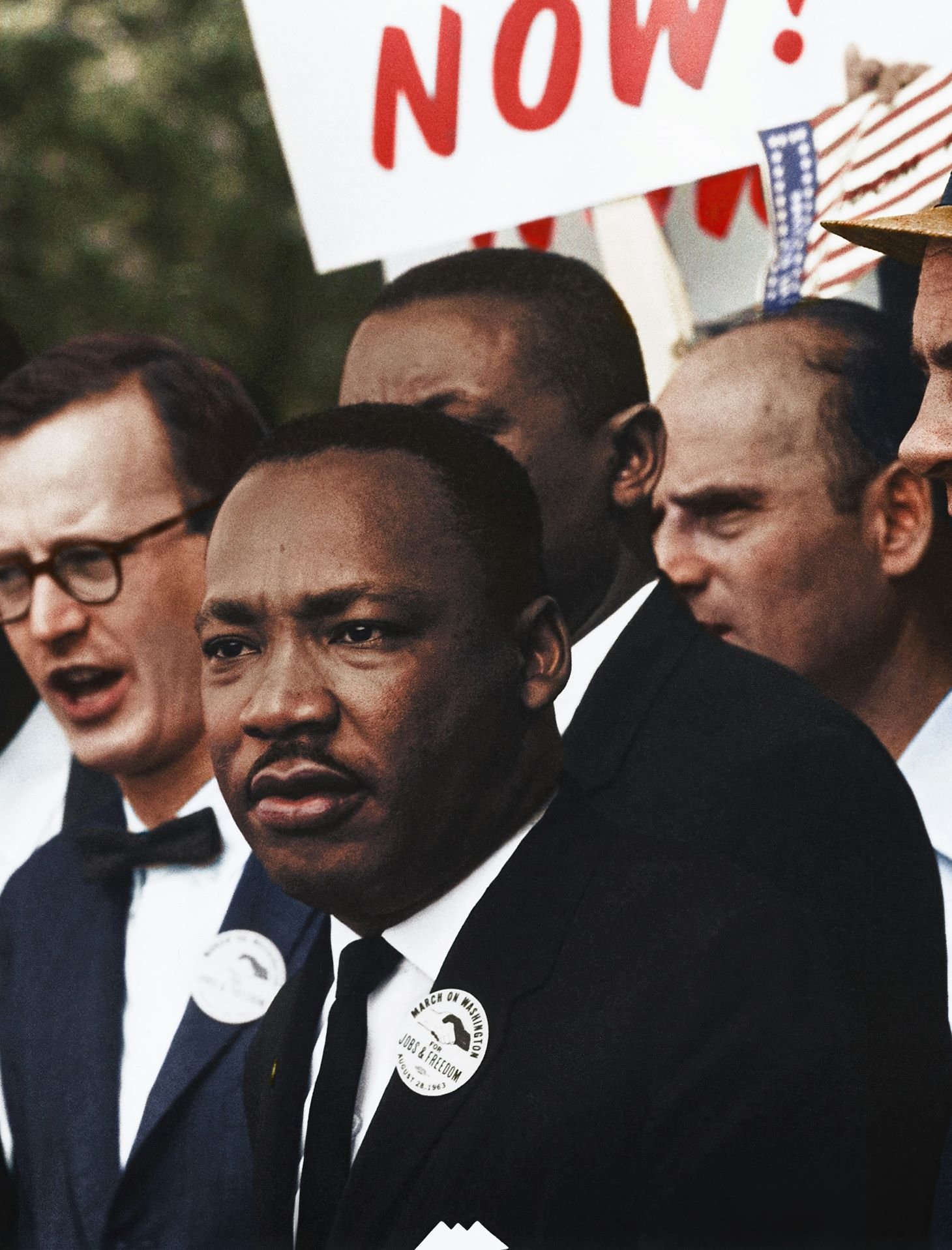

Authors and psychologists tend to agree that effective leaders have strong emotional intelligence. Emotional intelligence, some say, enables leaders to remain calm in stressful situations, maintain composure when faced with uncertainty, and adapt effectively in a crisis. Emotionally intelligent leaders provide stability during periods of change. They provide direction when no one is sure which way to go. That’s a lot of things for emotional intelligence to accomplish!
Although the term wasn’t in vogue during Martin Luther King Jr.’s lifetime, King exemplified emotional intelligence in his leadership. He clearly empathized with others, a key component of emotional intelligence. He understood differing perspectives, another crucial component of emotional intelligence.
MLK’s emotional intelligence helped him build strong relationships, the kind of relationships necessary to form a coalition. It wasn’t all sunshine and roses within the coalitions that he formed, but they were successful coalitions. Coalitions that got results and inspired others. Inspired a nation in fact. Perhaps inspired much of the world.
Dr. King committed to nonviolence and to resisting the oppressive Jim Crow norms he was forced to confront. Both were emotionally intelligent commitments. Certainly emotional intelligence was key to Martin Luther King’s ability to mobilize other people to fight for civil rights. And it galvanized King’s inspirational speaking style. King made civil rights for Black folks seem like something that every human being aspired to and supported deep down in their hearts.
In some ways, now that our only view of Dr. King involves hindsight, it is tempting to think that MLK made the absolutely monumental task of dismantling the intellectual and emotional appeal of Jim Crow laws easy. It wasn’t easy. It wasn’t even necessarily plausible. All his efforts might have come to nothing if the members of Supreme Court of the time had been less emotionally intelligent themselves. The Supreme Court ultimately declared unconstitutional the bus segregation MLK’s boycott had targeted.
Emotional Intelligence in Times of Stress
But for things to get to the point where the Supreme Court would weigh in against discriminatory segregation, MLK endured periods of almost unending, unimaginable stress. He was harassed. His home was bombed. And the people he mobilized were put in danger. You may have seen pictures of dogs being set upon protesters in Birmingham, Alabama in the 1960s. If not, here’s one:
The people of the United States saw images like those and even more graphic ones than that. They saw harrowing images of firehoses turned on peaceful protesters. They saw all this on their TV screens, splashed on the front pages of theirs newspapers, and blaring from the covers of their magazines. And the people of the United States came to a conclusion. They came to the conclusion that what they were seeing was horrible.
Horrible enough that young people jumped into action to join the protestors. Those young people, who didn’t have to join the protests, and those photographers, who were in danger themselves, showed great courage on behalf of others. They showed that courage partly because King inspired them.
Certainly there were Black leaders before and after Dr. King who didn’t push as hard as he did, with as much finesse or as much success. For Dr. King, desegregating the South was both a moral and a practical endeavor, increasingly informed by his understanding of the economics of poverty. Dr. King revealed the extent of his concern with poverty and economics when he returned from Norway after receiving the Nobel Peace Prize.
King wanted to focus on poor workers and unionizing. Other civil rights leaders, such as those in the Urban League, were primarily concerned with the kind of explicit race-based discrimination represented by Jim Crow laws. But King’s worldview was formed by fusing an intellectual outlook and continuing intellectual curiosity with a moral and religious framework.
Intellectual and Emotional Intelligence
King’s emotional intelligence was always counterbalanced (and perhaps made more effective) by a striving for intellectual rigor and legitimacy. He thought as well as preached.
The combination of intellectual and emotional intelligence helped King stay steady as the bus boycotts and legal fights in Montgomery, Alabama (where King preached at the Dexter Avenue Baptist Church) dragged on for a year.
A year is nothing in the grand scheme of things. Only a year to desegregate buses in a place where the roots of segregation ran very deep. That’s an astonishing accomplishment. But a year of stress and fighting against entrenched hatred can seem like a mighty long time indeed to the person who is leading the charge.

Confronted with Uncertainty
It’s not just the stress of continuous conflict that weighs on a leader. It is the uncertainty. We all know that Dr. King prevailed in many of his struggles. But the outcomes were uncertain at the time. When Dr. King wrote ‘Letter From Birmingham Jail,’ he was in fact in a Birmingham jail. A court order had declared it unlawful for him to protest. He protested anyway.
Emotional and moral intelligence gave King certainty that his cause was just and that defying the unjust court order was the right thing to do. This is the sort of decision that leaders today still need to make.
Around the world, and in the United States, there are efforts afoot to criminalize various forms of protest. Not surprising – powers that be almost never like to be protested against. Protests are perhaps the most effective weapons citizens can wage against their governments. For this very reason, protests are essential to freedom.
These days, as has happened many times before, various voices call for students on college campuses to be prevented from protesting. This time, folks don’t want them to protest the war between Hamas and Israel. Back in the 1970s, students literally died protesting the Vietnam War. The United States government, in the form of the Ohio National Guard, killed 4 students at Kent State University.
Those killing were wrong back then, attempting to criminalize Martin Luther King, Jr. was wrong, and attempting to criminalize and shut down student protestors today is wrong.
Do you have the emotional intelligence, courage, and moral certainty to go to jail for your convictions? MLK did.
Emotional Intelligence is Strategic During a Crisis
It’s not just courage and moral certainty that drive nonviolent social change. King had a strategy as well. The strategy involved using black churches to organize the movement on a local level. In other words, King leveraged socially cohesive organizations that were already in place.
One of the key mistakes public health leaders made during the pandemic crisis, in my opinion, is that they failed to leverage networks of strong churches and faith-based organizations in their states. In contrast, people who wanted to protest against public health measures did leverage church organization. It is not by any means a given that churches would be against public health measures, but initial government attempts to curtail church attendance to stop the spread of the SARS-COV-2 virus turned many of the faithful against public health authorities.
Overlooking the importance of faith in people’s lives is a key example of what goes wrong when leaders do NOT show emotional intelligence. Indeed, overlooking the importance of existing social organizations in general is a key failing of leaders who don’t have strong emotional intelligence.
A Stable Relationship
Another emotionally intelligent move King made was to marry Coretta Scott King, who was his equal and a formidable partner who brought stability to King’s life. King didn’t have particularly progressive attitudes towards women’s rights, but he did have the brains to realize he needed a partner he could commune with. Emotionally intelligent leaders tend to partner with others who can provide balance by being equally strong in other areas. Having a partner who is as strong as you are can help keep you grounded, allay the natural anxiety and stress associated with leadership, and keep you on an even keel as your efforts toward change bear fruit.
Indeed, in his autobiography, King stated:
“I didn’t want a wife I couldn’t communicate with.
Biography of Civil Rights Leader Martin Luther King Jr. (thoughtco.com)
Attitudes and Beliefs of Emotional Intelligence
Finally, emotional intelligence is a matter of underlying attitudes and beliefs. These beliefs provide direction during tumultuous times when it is difficult to know which way to go. Here are some examples of King’s principles that reflect emotional intelligence:
- Seek Friendship and Understanding. Don’t seek to defeat or humiliate an opponent, King advised, but instead to win his friendship and understanding. The purpose of his words and actions was to “to awaken a sense of moral shame in the opponent” and the ultimate goal was “redemption and reconciliation.”
- Invoke a Higher Purpose: King gave his supporters a sense of higher stakes and greater purpose. A bus boycott is not just about refusing to get on a segregated bus. It is about supporting the universe and God’s underlying love for justice for all. King could remind the protestors harassed by the civil authorities in the South that, for all their suffering (and there was suffering indeed), love and justice always prevail in the end.
Humans want love and justice to win in the long run, and deep down, they believe it does. Even those who have become cynical after witnessing widespread hate and injustice want love and justice to prevail. The universal human longing for love and justice can pull in people who aren’t otherwise motivated to get involved. King’s appeals to love and justice attracted donations, white allies, larger crowds at demonstrations, and the respect of the world community.
Of course, we can’t overlook how King’s personal story ended. On April 4, 1968, Martin Luther King, Jr. went outside his motel room in Memphis, Tennessee and walked on to the balcony. There he was shot and killed. His funeral was held 5 days later, on April 9, 1968.
Emotional intelligence alone does not overcome the violence that so many hold in their hearts. The truth is, it is easier in some ways to hate than to love. Unconditional love for those who seem to seek to do you harm is hard. Emotional intelligence takes effort.
Yet, every step any one of us takes toward love and emotional intelligence inches us all closer toward the ideal of justice that we all, even our enemies, long for.
Discover more from Get Pretty Fed Up
Subscribe to get the latest posts sent to your email.