
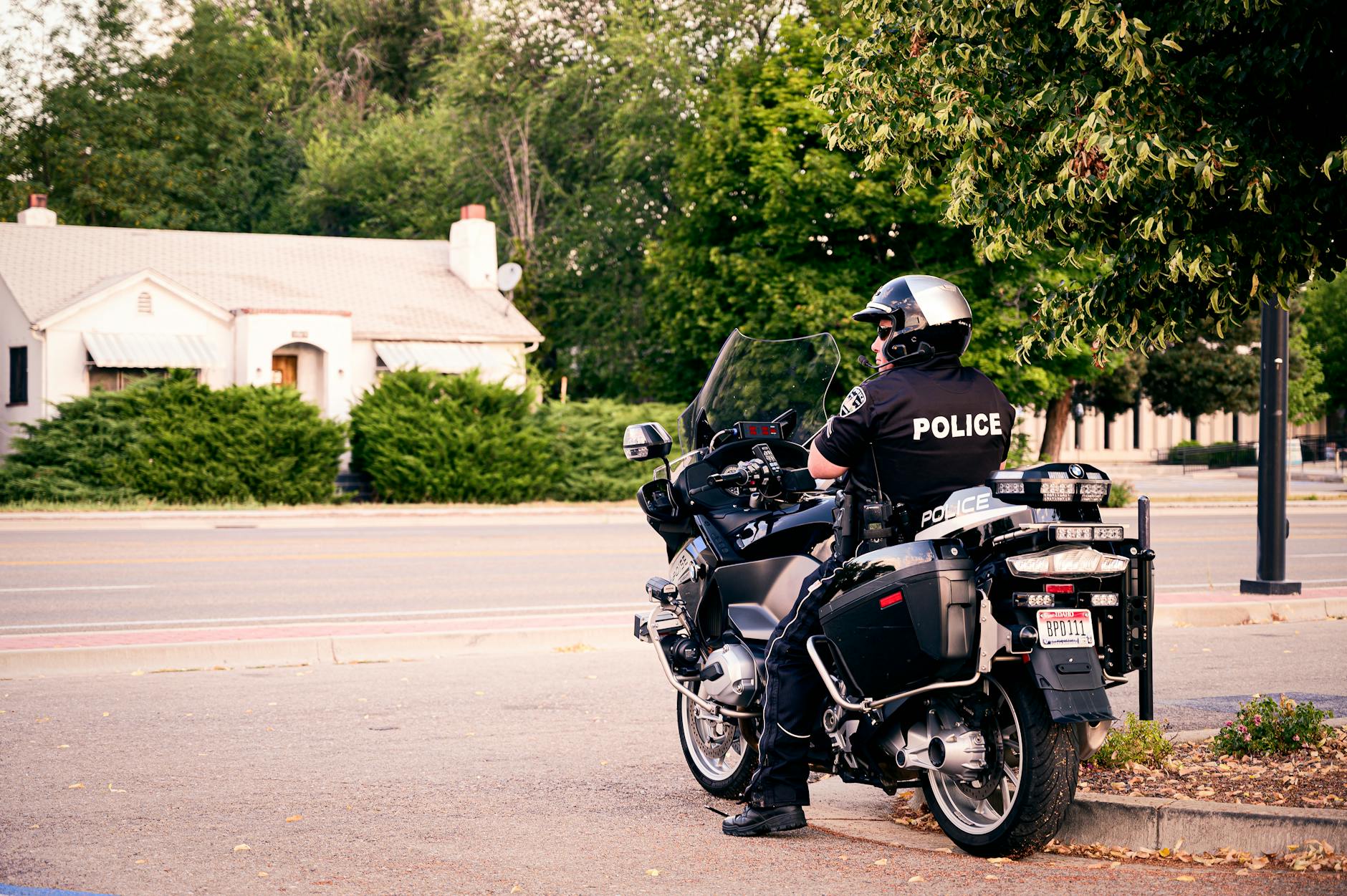
It seems like safe and healthy cities are a human right, ya know? A right in the sense that anyone with any sense at all can agree it is preferable to live in a city that is safe and healthy as opposed to living in a city that is unsafe and unhealthy. The desires for a certain level of safety and health are built right into human nature, which does not particularly like feeling terrified and lousy.
So far, so good. Reasonable levels of safety and health – thumbs up. Unreasonable levels of unsafety and disease – thumbs down. So why do cities seem to operate with a much greater emphasis on apparent safety than they do on health?
Cities in the US spend around $650 per person on police and fire services per person on average (figures vary depending on who you consult and when). Police departments account for an average of 19% of city spending. Well that’s some money spent on making cities safe, amirite? Except –
The police actually kill a fair number of people and – as far as reducing both crime and the number of civilians killed by police – investing in education seems to be the way to go.
Meanwhile, air pollution alone kills millions around the world each year. Seven million seems to be a reasonable estimate, which is sooooooo much more than homicide.
Yup only around .7% of deaths each year (around the world) are due to homicide. That’s hundreds of thousands of people. But it’s not millions of people. Yeah, disappointing as it may be to you true crime buffs out there, you are much more likely to die of the cumulative effects of bad air than murder.
The losses to the world (and the world economy) due to the not-so-healthy priorities of cities are staggering. For example:
PM2.5 is one of the most closely tracked elements of air pollution. PM2.5 is made of tiny particles that can get into a person’s blood stream and cause havoc in all the major organs of the body. It gets into the air via coal and oil burning, dust storms, wildfires, and other fun stuff. Strokes and lung cancer are among the effects that exposure to too much PM2.5 can have. The WHO recommends keeping PM2.5 levels to 5 or below.
In 2023 Columbus, Ohio, was rated as the most polluted major U.S. city with an average PM2.5 level of 13.9. That’s about 3 times the WHO’s recommendation. (Las Vegas, Nevada was ranked the least polluted major U.S. city with an average PM2.5 level of 4.9. Viva Las Vegas!)
Ohio didn’t produce its own pollution in this case, it accidentally imported it from Canada, which was having a wildfire season to beat all wildfire seasons. That’s a tough problem. But…
Columbus spends around $750,000,000 annually on public safety. It spends about $45,450,000 on public health. That’s about 17 times more on police and fire and 911 than on public health. If Columbus invested 750 million dollars in public health, or even that much money on reducing certain pollutants, it would seemingly get a very large payout in terms of health benefits.
The EPA quantifies the health benefits of reducing certain forms of air pollution at around $3 to $9 for every dollar spent. A $750 million dollar investment in reducing air pollution therefore would produce at the very least billions of dollars in benefits.
So let’s look a little more closely at average expenditures by local governments in the US in 2017: 48.6% on education, by far the largest expense. 14% on police, fire, and courts. 7.7% on transportation. And around 6.8% on public health, environment, and natural resources.
Here’s a somewhat more recent chart on police spending in U.S. Cities:
 You will find more infographics at Statista
Now cities aren’t spending all this money on the police and so little money on public health and environmental issues because spending money on police is so much fun!
Nope, cities and counties and other local government jurisdictions put their money into policing because they perceive demand for it.
“Demand for policing services has gone up even as crime rates have dropped, in part because of the increasing complexity of police work, both in terms of greater regulatory requirements and increasingly complex crimes such as cybercrime and identity theft.”
Making Police More Affordable: Managing Costs and Measuring Value in Policing | Office of Justice Programs (ojp.gov)
Now who exactly is demanding more policing services isn’t exactly clear. It may be the police themselves that are demanding more policing services. In the wake of the murder of George Floyd and subsequent protests, the phrase “defund the police” was bandied about. Now, as phrases go, that one was probably about as stupid a phrase as a leftist could come up with, and leftists are geniuses at coming up with stupid phrases. It’s not exactly true that every leftist in the United States consults with the VERY BIG BOOK OF VERY BAD CATCHPHRASES, but enough do (thank you academia once again, thank you) that the US left manages to spit out very bad catchphrases with alarming regularity.
So law enforcement agencies of various sorts (hey, Alex Villanueva, so glad you’re gone and hope you never come back) started bandying about the counter-idea that police departments were being defunded and therefore crime was going up.
Police departments were not being defunded. In fact, 49 cities or counties tracked by this study, increased their budgets by over 10%.
Now it really shouldn’t be a surprise that sheriffs and other law enforcement personnel would lie to get more money, claim they are being defunded when they’re not. It seems that everybody lies these days to get more money. The Republicans may or may not have made America great again, but they sure have managed to make lying very very very popular. And that’s an achievement, because it’s not like lying has ever been unpopular exactly. But to make non-stop pathological lying a badge of honor – well, that’s an achievement in undermining basic human morality that needs to be acknowledged.
Police Budgets and Crime Rates Not Linked
People do get surprised though by the undeniable reality that police officers lie like everyone else. What they should get surprised by is the lack of evidence tying police budgets to crime rates. Every dollar spent on public safety does not produce $3 to $9 in equivalent benefits to public safety, health, economic growth or anything else.
It’s not that spending exactly zero on policing would lead to an ideal world. I mean, if we already lived in an ideal world, then spending zero on policing would make sense. But we don’t live in an ideal world. And the reality is that people want safety as well as health. And safety is a matter of perception.
So let’s go back to funding for police and take a look at some numbers, just for some safety-related fun. We’ll take a look at California. California is a favorite red state punching bag. That’s partly because about 1 out of every 12 Americans lives in California and it has an economy larger than that of many nations. This is disappointing to red states because California is a blue state. It’s a gloomy fact that a blue state is both very large and very rich and hasn’t died of being too progressive yet.
Red states can take comfort in that there is plenty that’s fucked up everywhere, so there will be at least a certain amount of bad news for California on a periodic if not continuous basis. They can also take comfort in the fact that folks in blue states like California and New York also consider it a gloomy fact that Texas still exists and hasn’t successfully seceded yet or at least fallen in to the ocean from too many asshole extreme conservatives. If you can’t make blue staters miserable by proving that voting for Democrats makes them all die from the COVID-19 vaccine, at least you can make them miserable by continuing to exist!
Back to the numbers. California has lost a lot of law enforcement staffing since 2008. We can look at a few examples. Patrol officers in the city of Stockton dropped by 7% (per capita) between 2008 and 2021. Alameda County dropped by 18% and Sacramento County by 21% during the same period. That seems kind of significant.
Overall, California lost about 5,300 patrol officers between 2008 and 2021. With that level of decrease, you can kind of see why police officers would be among the groups calling the loudest for more police officers! People rarely like to see their staffing numbers go down in any job, whether through layoffs or attrition or what have you. Even if things are not so terrible with reduced numbers, people tend to dislike dramatic change of any sort in their jobs, and people especially tend to dislike anything that feels like a loss.
But the data doesn’t really show that there’s much of a correlation between spending on police and crime rates. Remember our friends in Stockton, California who lost 7% of their officers between 2008 and 2021? The crime rate in that city has fluctuated over that period of time. But it has not consistently risen and the fluctuations don’t correlate with the per capita number of police officers. Various things affect crime rates, including economic conditions and recessions, but police presence doesn’t have a discernible effect. That doesn’t mean it has no effect – just that the effect isn’t cut and dried, just like a lot of the other factors that affect crime rates. Stockton, by the way, is about average in its crime rate.
Crime Rates in Cities with Reduced Police Staffing
Well how about Alameda and Sacramento counties? They lost a much higher chunk of their police force than Stockton. 21% is three times a bigger loss than 7% after all.
Well in Alameda County, the violent crime rate is actually down since 2009. It decreased. An 18% drop in police officers and the violent crime rate decreased. And that’s after a big pandemic-related spike. A significant reduction in law enforcement personnel did not result in a significant increase in crime. Just the opposite.
Sacramento, however, is a different story. Sacramento, quite stubbornly (as cities tend to be) spends less on police and has higher crime rates than your average city. Sacramento could probably profitably invest in more policing. But even here the data doesn’t paint a clear picture. In spite of the decreases in law enforcement staff, violent crime in Sacramento dropped in 2019 to its lowest point in decades, with some areas seeing a 28% drop in violent crime. This was not due to a flood of new police officers.
Sacramento, like Stockton and Alameda County, fluctuates in its crime rate. Crime down in 2014 (yay 2014!) up in 2020 (boos all around for 2020, what a terrible year everywhere). In 2009 (remember the Great Recession?) property crime is Sacramento was way high. Not as much nowadays.
Put bluntly, it does appear that it is police officers that deter crime.
So what does deter crime? Well, apparently the US doesn’t know, at least compared to Japan, where the crime rate is much lower. Perhaps it is living in a polite society, one with regard for the feelings of others, that deters people from deliberately wounding others. Perhaps it’s religion. These guesses are at least as good as the guess that it’s a high ratio of police to civilians that deters crime. And these alternate suggestions cost a governments a lot less money!
Demand for Policing
So why do people (some people) demand more policing?
Well of course your ideas on the subject depend on your perspective. If you’re an Asian American in California, then a lot of your fellow Asian Americans when surveyed about policing in your area, give it decent marks, good or excellent. And a majority of your fellow Asian Americans, when surveyed, believe that the police treat everyone fairly, regardless of race or ethnicity, at least most of the time.
If you’re a Black Californian, you are not so likely to agree with these assessments. In fact, 63% of surveyed Black Californians explicitly disagree with the sentiment that the police are ‘fair’ or ‘equal’ in their treatment of different races and ethnicities. (And the Black Californians would be right, by the way.)
So if you’re a Black Californian and things are not working so well as far as you’re concerned, then you might think more policing in your area would pay off. Less violent and property crime for each additional officer assigned to patrol your area. Or you might think that each additional police officer running around being unfair and unequal will increase problems in your neighborhood.
In other words, if your area is underpoliced (nobody seems to give a shit, police seem to be like ‘crime in your neighborhood – deal with it’), then you might want more investment in policing. If you live in an overpoliced area (people constantly being harassed and arrested over nothing), then you might want the police presence to be cut back.
The perceptions that people have of police and crime don’t necessarily correspond with objective reality, as perceptions so often don’t. A relatively recent (November 2023) Gallup poll recorded some pretty alarming sentiments from Americans about crime:
- 63% said crime is an extremely serious problem
- 28% reported their household as being victimized by a crime.
This crime, however, is not necessarily in their own local area. Only 17% report that crime is an extremely serious problem where they live. Less even than those who report someone in their household being victimized by a crime.
Current Perceptions of Crime
Even more Americans surveyed, 77%, believe crime has increased since a year before they were surveyed. That’s a pessimistic take on crime! And that’s after a year earlier, in which the survey revealed that 56% believed that crime had increased in their local area. There was also an increase in adults reporting that they personally had been a victim of a crime in the last year – up from 14% in 2021 to 17% in the last survey. And about 35% of people say they don’t report the crime that victimized them or someone in their household.
And yet…. almost 5 times as many people think that the economy and inflation are bigger problems. Back in the 1990’s, 42% of survey respondents believed that crime was the most serious problem in the country.
The reason so many people thought that crime was the most serious problem in the country back then was that crime rates were waaaaay higher back then. According to the FBI, the rate of violent crimes these days is among the lowest ever recorded.
But…Republicans like to make it seem like the country is experiencing some sort of crime wave it’s not experiencing. In other words, they lie about crime, the way some lie about ‘defunding.’ The news media, tend not to run stories like “California area not experiencing crime wave today!’ Nor do people on social media like NextDoor or Facebook tend to post things like ‘Amazon package delivered to my house today – not stolen!’
This is partly because a murder will kill you today and air pollution will kill you tomorrow. You’re not going to have to worry about dying of an air-pollution caused stroke at 63 if you died of someone shooting you in the head at 56.
A lack of crime is actually normal! What news is what’s not normal. Most of the time, day in, day out, most people, in most places around the world and around the country, are not experiencing or perpetrating crimes.
Indeed, almost everyone, around the country, is reacting to the manufactured issue of crime these days with a shrug.
What does this mean to you, the alert reader who like every normal person values both safety and health in your city? It means that next time someone tries to sell you a bill of goods about crime rising, take a brief moment to abandon your entirely justified shrug to GET PRETTY FED UP and yell your head off at those people to STFU and start worrying about the air pollution that kills millions.
If the air pollution hasn’t fried your vocal cords already of course.
Discover more from Get Pretty Fed Up
Subscribe to get the latest posts sent to your email.
Air pollution is also implicated as a factor in dementia conditions, such as Alzheimer’s disease: https://health.ucdavis.edu/conditions/neurology/neurodegenerative-diseases
Thanks for sharing. I read many of your blog posts, cool, your blog is very good.